A patient lift provides a safe and comfortable way to transfer people who have difficulty moving independently. Different types of patient lifts are designed for different transfer needs, levels of mobility and cooperation, weight capacities, and care environments. When selecting a patient lift, it is important to consider the person’s mobility, weight, transfer requirements, and the environment in which the lift will be used.
What Is a Patient Lift?
A patient lift is designed to help move a person safely from one location to another when they cannot transfer independently or safely. Most patient lifts use a sling to support the person during the transfer, helping reduce the physical effort required from caregivers.
Types of Patient Lifts
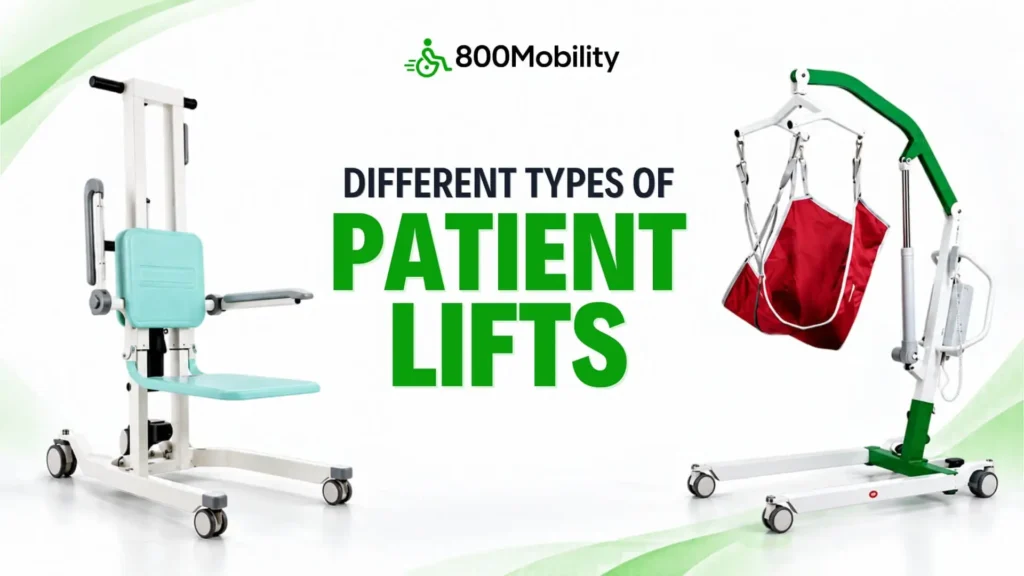
Patient lifts are generally categorized as floor lifts, sit-to-stand lifts, ceiling lifts, bariatric lifts, bath lifts, and pool lifts. Each type is designed for specific transfer situations and care requirements.
Floor Lifts
Floor lifts are mobile patient lifts that move across the floor on casters and support the person’s weight with a sling. They are useful when a ceiling lift is not practical, such as in homes, hospitals, and care facilities.
Floor lifts can be used for transfers between beds, chairs, wheelchairs, and other surfaces. Because the sling supports the person’s weight, the individual does not necessarily need to be able to stand or bear weight during the transfer.
Manual Floor Lifts
Manual floor lifts use a hydraulic lifting mechanism rather than an electric motor. They do not require batteries or electrical charging, making them a practical option in environments where a manually operated lift is appropriate.
Electric Floor Lifts
Electric floor lifts use a powered mechanism to raise and lower the person, reducing the need for manual effort from the caregiver. They can be particularly useful when transfers are performed frequently.
Sit-to-Stand Lifts (Standing Lifts)
Sit-to-stand lifts are designed for people who can bear some weight through their legs but cannot stand independently. Unlike full-body floor or ceiling lifts, which support the person’s entire weight with a sling, sit-to-stand lifts assist the person in moving from a seated to a standing position.
The person sits on the lift, places their feet on the footplate, and holds the support handles while the powered or mechanical mechanism assists them into a standing position. The caregiver controls the transfer throughout the process.
For appropriate users, sit-to-stand lifts can make transfers more efficient and less disruptive than full-body lifts. They may be suitable for people recovering from orthopedic surgery, those with partial lower-limb weakness, or those who have become physically deconditioned.
However, a sit-to-stand lift is not appropriate for someone who cannot bear weight through their legs. Attempting a standing transfer with a person who is completely non-weight-bearing may increase the risk of injury to both the person and caregiver.
Sit-to-stand lifts can be useful for repeated transfers over short distances, such as from a bed to a wheelchair or from a chair to a toilet. They may also be practical in homes where available space is limited. The person should have sufficient leg strength, balance, and ability to follow instructions to participate safely in the transfer.
Overhead or Ceiling Lifts
Ceiling lifts are mounted to a ceiling track system. The track may run in a straight line or use a room-covering H-track or X-Y system, depending on the installation.
During a transfer, the person is positioned in a compatible sling attached to the overhead motor. The caregiver uses a hand control or pendant to raise, lower, and move the person along the track.
Ceiling lifts can be useful when frequent transfers are required or when floor space is limited.
Bariatric Lifts
Bariatric lifts are specialized patient lifts designed to accommodate people who require higher weight capacities and additional support during transfers.
Depending on the model, a bariatric lift may feature a higher weight capacity, reinforced construction, a wider base for stability, heavy-duty slings and straps, and a stronger lifting mechanism.
When choosing a bariatric lift, always check the manufacturer’s specified weight capacity rather than assuming that any bariatric lift is suitable for every person with a higher body weight. The lift, sling, and installation should all be appropriate for the individual’s needs and the intended transfer.
Regardless of the type of patient lift used in a hospital, care facility, or home, safe operation depends on selecting appropriate equipment and ensuring that caregivers are trained to use it correctly. The person’s mobility, physical abilities, and transfer requirements should always guide equipment selection.
Bath Lifts
A bath lift is designed to assist with getting into and out of a bathtub. It can be useful for people who can safely enter and exit a bathtub with assistance but have difficulty stepping over the tub edge or lowering and raising themselves from the bottom of the tub.
Bath lifts are used in homes, rehabilitation settings, and long-term care environments. They are designed specifically for bathing and should not be considered a general-purpose patient transfer lift.
Depending on the design, bath lifts can help reduce the physical effort required from the caregiver, support safer bathing, and provide a more comfortable bathing experience. Some models also offer reclining functions for additional comfort.
Pool Lifts
Pool lifts are used in pools, recreation centers, clinics, and hospitals to help people with mobility limitations enter and exit the water. They can support access to swimming, aquatic therapy, exercise, and recreational activities.
Access to an aquatic environment can allow people with mobility limitations to participate in water-based activities and therapy. Pool lifts can also make transfers into and out of the pool easier for both the individual and caregiver.
The number and placement of pool lifts required depends on factors such as the pool’s size and layout and the type of lift system being installed. Appropriate staff training and safe operating procedures are also important.