Stairs can be a significant barrier for wheelchair users in homes, workplaces, and public buildings. However, various accessibility solutions can make it easier to navigate stairs safely and comfortably. Stairlifts, platform lifts, and stair climbers are among the mobility solutions available to help people of determination access different levels of a building.
In this blog, we explore the different stair-climbing options available at 800 Mobility and explain how to choose the right solution based on individual mobility needs and staircase design.
How Can Wheelchair Users Get Up and Down Stairs?
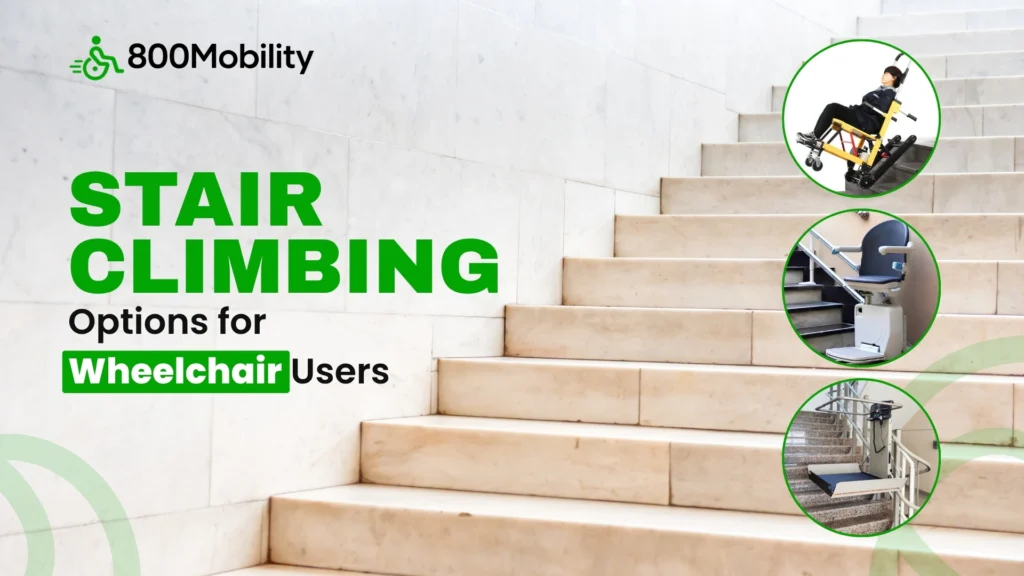
Advances in accessibility technology have made it easier for wheelchair users to navigate stairs. The most common solutions include:
- Stairlifts: Allow users to travel up and down stairs while seated on a powered lift seat that moves along a rail.
- Platform lifts: Allow wheelchair users to travel between levels while remaining in their wheelchair.
- Stair climbers: Help move a user and their wheelchair up and down stairs using a powered track or wheel-based system.
Each type of mobility equipment has different features, applications, and installation requirements.
Stair Climber Solutions for Wheelchair Users
Stair climbers are designed to help wheelchair users travel up and down stairs while remaining in their wheelchair. Depending on the model, they may use tracks or wheels to move across the stairs.
Many portable stair climbers do not require permanent structural modifications and can be used on different staircases, provided the equipment is compatible with the staircase and wheelchair.
The suitability of a wheelchair stair climber depends on several factors, including:
- The operator’s experience and ability to use the equipment safely.
- The design and condition of the staircase, including its width, landing areas, slope, and steepness.
- Whether the wheelchair is manual or powered.
- The weight capacity of the stair climber.
- The dimensions and specifications of the wheelchair.
Stairlifts
Stairlifts are powered seats that travel along a rail installed on the staircase. They are available in straight and curved configurations to suit different staircase layouts.
A stairlift can be a practical option for users who are able to transfer from their wheelchair to the stairlift seat. It allows them to travel between floors while remaining seated in an upright position.
The type of stairlift required depends on the shape and configuration of the staircase.
Wheelchair Platform Lifts
Wheelchair platform lifts allow users to travel between different levels while remaining in their wheelchair. They are commonly divided into two main types:
Vertical Platform Lifts
Vertical platform lifts move straight up and down between levels. They can be suitable for raised entrances, porches, and other areas where vertical access is required.
Inclined Platform Lifts
Inclined platform lifts travel along rails installed across a staircase. They can be useful where a vertical platform lift is not practical. Many models feature a foldable platform, helping reduce the amount of space occupied when the lift is not in use.
Platform lifts can be used in homes, healthcare facilities, rehabilitation centres, and public-access buildings. They can support substantial loads, although their space requirements and installation needs vary by model. Some installations may also require modifications to the building.
How to Choose the Right Stair-Climbing Solution
Choosing the right stair-climbing solution depends on the user’s mobility needs, wheelchair, staircase, available space, and intended frequency of use. Consider the following factors:
Staircase Design
Consider the shape and layout of the staircase. Straight staircases generally allow simpler installations, while curved, spiral, or narrow staircases may require more specialised solutions.
Wheelchair Type and Size
Check whether the equipment is compatible with a manual or powered wheelchair. The wheelchair’s width, length, height, and weight should be considered, along with the equipment’s maximum weight capacity. Powered wheelchairs may also be heavier because of their batteries.
User Mobility
The user’s ability to transfer between the wheelchair and another seat is an important consideration. If the user can safely transfer to a stairlift seat, a stairlift may be suitable. If they need to remain in their wheelchair, a platform lift or compatible stair-climbing device may be more appropriate.
Available Space
Consider the amount of space available for installation and operation. Platform lifts generally require more space than some other stair-access solutions, depending on the model and installation location.
Frequency of Use
Consider how frequently the equipment will be used. A permanent installation may be appropriate for regular daily use, while a portable solution may be more suitable for temporary or occasional requirements, provided it meets the user’s needs and staircase specifications.
Installation Requirements
Check whether installation requires approval from local authorities or building management. It is also important to determine whether a permanent or temporary installation is suitable for the property.
Safety Considerations for Wheelchair Stair Access
Safety should always be a priority when using wheelchair stair-access equipment. Important safety considerations include:
- Ensure the wheelchair is securely positioned and locked according to the equipment manufacturer’s instructions before movement begins.
- Never exceed the equipment’s specified weight capacity.
- Check that essential safety features, such as platform barriers, seat belts, braking systems, and anti-roll mechanisms, are functioning correctly.
- Follow all operating instructions provided by the manufacturer.
- Make sure users and operators receive appropriate training before operating the equipment independently.
- Keep the staircase and the equipment’s travel path clear of obstacles.
- Ensure surfaces are suitable for safe operation and are free from conditions that could increase the risk of slipping.
- Have equipment installed by qualified technicians where professional installation is required.
- Check important safety features such as battery backup, obstacle sensors, and emergency-stop systems where applicable.
- Arrange regular inspections and maintenance according to the manufacturer’s recommendations.
Getting Professional Advice Before Choosing a Solution
Choosing the right stair-climbing solution requires consideration of the user’s wheelchair, mobility needs, staircase design, available space, building structure, and frequency of use. Consulting a mobility specialist can help identify a solution that is suitable for the specific environment and user requirements.
At 800 Mobility, we provide mobility solutions for people of determination in the UAE. Contact us for professional guidance on selecting a suitable stair climber or other wheelchair-access solution based on your needs.